

Maharashtra · Scholarship 2025
Scholarship 2025 — Std 8 Paper I
Pre-Secondary Scholarship Examination held on 9 February 2025. English Medium, English and Mathematics. All 75 questions with the official MSCE answer key and short explanations. Practise online, or print the clean A4 paper.
75Questions
150Marks
90Minutes
EnglishMedium
0 marks
0 of 75 attempted
MAK LABS · maklabs.in
Pre-Secondary Scholarship Examination (Std 8), February 2025
Paper I — First Language and Mathematics
Maharashtra State Council of Examination, Pune
Instructions
- This paper has two sections. Section I has questions 1 to 25 of First Language. Section II has questions 26 to 75 of Mathematics. All 75 questions are compulsory.
- All questions carry 2 marks each.
- Time limit to solve the paper is 90 minutes.
- Each question has four options. Choose the correct option.
- Some questions say ‘Select two correct alternatives’. For these, both correct options must be chosen to get the marks.
- The answer key is given at the end of this paper.
Section I — First Language : English
Questions 1 to 251.Choose the correct alternatives for the following.
Aniket and Ketki had their breakfast and lunch at the same time at 11.00 am. So we can say that they had their __________ that day.
Aniket and Ketki had their breakfast and lunch at the same time at 11.00 am. So we can say that they had their __________ that day.
- (1) food
- (2) lunch
- (3) dinner
- (4) brunch
Why: A late-morning meal that takes the place of breakfast and lunch is called brunch (breakfast + lunch).
2.Choose the correct option for the underlined word.
Our Sanskrit teacher told us to write an extract on ‘the usefulness of Mahisha’
What is the meaning of an underlined word.
Our Sanskrit teacher told us to write an extract on ‘the usefulness of Mahisha’
What is the meaning of an underlined word.
- (1) Manisha
- (2) buffalo
- (3) month
- (4) wish
Why: In Sanskrit, ‘Mahisha’ means a buffalo.
3.Choose a correct option.
Society elected Sakshi a fellow at the age of 25, which is very remarkable thing.
Society elected Sakshi a fellow at the age of 25, which is very remarkable thing.
- (1) a scholarship given by the royal society.
- (2) the money given the society.
- (3) a certificate given by society.
- (4) an award, title and honour given by the royal society.
Why: Being elected a ‘fellow’ of a society is an honour and a title given to a distinguished person.
4.Find out 2 correct antonyms for the given word.
‘Light’ Two correct options
‘Light’ Two correct options
- (1) many
- (2) stable
- (3) heavy
- (4) dark
Why: ‘Light’ has two meanings. Light (not heavy) × heavy. Light (bright) × dark.
5.Choose two correct alternatives of correct auxiliaries showing permission in the following.
You __________ go now. Two correct options
You __________ go now. Two correct options
- (1) would
- (2) can
- (3) may
- (4) should
Why: ‘Can’ and ‘may’ are used to give permission. ‘Should’ shows duty and ‘would’ shows habit or a wish.
6.Choose the correct sentence by changing it into negative form.
I was doubtful whether it was you.
I was doubtful whether it was you.
- (1) I was not sure that it was you.
- (2) I was sure that it was you.
- (3) He was sure not that he was I.
- (4) He was not sure that it was him.
Why: ‘Doubtful’ means ‘not sure’. The meaning stays the same: I was not sure that it was you.
7.Identify the types of sentences by choosing the correct option.
As it was begining to rain, we waited there for a while.
As it was begining to rain, we waited there for a while.
- (1) simple
- (2) interrogative
- (3) complex
- (4) compound
Why: ‘We waited there for a while’ is the main clause. ‘As it was beginning to rain’ is a subordinate clause. A sentence with a main clause and a subordinate clause is complex.
8.Find compound conjunctions form of the given sentence.
I will forgive you on condition that you do not repeat the offense.
I will forgive you on condition that you do not repeat the offense.
- (1) do not repeat
- (2) on condition that
- (3) will forgive you
- (4) that you do
Why: ‘On condition that’ is a group of words that joins two clauses. It is a compound conjunction.
9.Find out the error and choose the correct alternative for the following example of indirect speech.
Ramesh said that he wants to be the soldier.
Ramesh said that he wants to be the soldier.
- (1) wants
- (2) said
- (3) that
- (4) to be
Why: The reporting verb ‘said’ is in the past tense. So ‘wants’ changes to ‘wanted’. The MSCE final answer key also accepts (2) ‘said’, since ‘says’ would also make the sentence correct.
Instructions for Q. 10 and Q. 11. Read the following news and answer the questions.
UNESCO adds two sites of India to the World Heritage ListReport by Prashasti Kulkarni This month, the United Nations Educational, Scientific and Cultural Organisation or UNESCO, added the Hoysala temples of Karnataka and Santiniketan, West Bengal to their list of World Heritage Sites.
These sites mark India’s 41st and 42nd contribution to the list, the first being the Ajanta Caves of Maharashtra, added in 1983.
UNESCO uses a specific criteria to decide which place, monument or area to add to the list every year, which includes points ranging from the architectural beauty of a place to its cultural significance.
UNESCO’s World Heritage Sites of September 2023, India.
As mentioned before, UNESCO added the Hoysala Temples of Belur, Karnataka and Santiniketan, West Bengal to the World Heritage list in September 2023.
10.Which another word is used in the above news for United Nations Educational, Scientific and Cultural Organisation.
- (1) Culture
- (2) UNESCO
- (3) World Heritage
- (4) United Nations
Why: UNESCO is the short form made from the first letters of the full name.
11.Match the pairs and choose the correct alternatives
| A | B |
|---|---|
| 1. Ajanta Caves | a. West Bengal |
| 2. Hoysala Temple | b. Maharashtra |
| 3. Santiniketan | c. Karnataka |
- (1) 1 – b; 2 – a; 3 – c
- (2) 1 – a; 2 – b; 3 – c
- (3) 1 – b; 2 – c; 3 – b
- (4) 1 – c; 2 – a; 3 – b
Why: The right pairs are 1 – b (Ajanta, Maharashtra), 2 – c (Hoysala, Karnataka) and 3 – a (Santiniketan, West Bengal). No option shows all three, so MSCE cancelled this question in the final answer key. Marks are given to all.
12.Which ‘wh-word’ is used to form the following sentence a question to get an underlined part as an answer.
The fox, the vulture and the Leopard took an oath of loyalty.
The fox, the vulture and the Leopard took an oath of loyalty.
- (1) How
- (2) Where
- (3) Who
- (4) What
Why: The underlined part is a thing. So we ask: What did the fox, the vulture and the leopard take?
13.Identify the underlined word and choose the correct option.
Cocks crow in the morning.
Cocks crow in the morning.
- (1) conjunction
- (2) noun
- (3) verb
- (4) preposition
Why: Here ‘crow’ tells what the cocks do. So it is a verb.
Instructions for Q. 14, Q. 15 and Q. 16. Read the poem and answer the questions.
“I never can do it”, the little Kite said,
As he looked at the others high over his head;
“I know I should fall if I tried to fly.”
“Try”, said the big Kite, “Only try!
Or I fear you never will learn at all.”
But the little Kite said, “I’m afraid I’ll fall”.
The big Kite nodded: “Ah, well, good-bye;
I’m off;” and he rose towards the tranquil sky.
Then the little Kite’s paper stirred at the sight,
And trembling he shook himself free for flight.
14.Why was the little Kite afraid?
- (1) that he would be tired soon.
- (2) to look down the earth.
- (3) that he would Fall.
- (4) that he would be caught by the birds.
Why: The little Kite says, “I’m afraid I’ll fall.”
15.Which encouraging words the Kite said to the little Kite?
- (1) try, only try
- (2) Fly, just fly
- (3) rise, look high
- (4) move, move around
Why: The big Kite says, “Try, only try!”
16.Who rose towards the sky?
- (1) little kite
- (2) big kite
- (3) birds
- (4) clouds
Why: The big Kite said good-bye and rose towards the tranquil sky.
17.Choose the correct option of word-ladder of
Warm to Cold
Warm to Cold
- (1) d, l, o, c
- (2) c, o, l, d
- (3) l, o, c, d
- (4) d, c, o, l
Why: Change one letter at a time: WARM → WARD (d) → CARD (c) → CORD (o) → COLD (l). The letters are d, c, o, l. The MSCE final answer key also accepts (2).
18.Find out the odd man out from the given sentences regarding the parts of speech.
- (1) Life is not a bed of red roses.
- (2) Speech is silver, but silence is golden.
- (3) We must love good and hate ill.
- (4) To err is human, to forgive is divine.
Why: MSCE cancelled this question in the final answer key. Marks are given to all.
19.Choose the correct alternative for the underlined word.
Rutu was ill. So she sent a message to her class-teacher. The class teacher replied, ‘take care’ - Which short form she might used for the underlined word.
Rutu was ill. So she sent a message to her class-teacher. The class teacher replied, ‘take care’ - Which short form she might used for the underlined word.
- (1) TK
- (2) TKE CRE
- (3) TK CR
- (4) TC
Why: In messages, ‘take care’ is written as TC.
20.Choose the correct option to complete the slogan.
__________ today, __________ tomorrow.
__________ today, __________ tomorrow.
- (1) leaders, learners
- (2) fact, dream
- (3) learners, leaders
- (4) elders, young
Why: The slogan is ‘Learners today, leaders tomorrow.’ Those who learn today will lead tomorrow.
Instructions for Q. 21, Q. 22 and Q. 23. Read the following extract and answer the questions.
The sound which is soothing to ears come in the form of a melody. The song can be irritating when it comes with a very high pitch and severity. It is strange but true that noise too can cause pollution. It has been found that noise pollution can weaken our hearing. Noise pollution is extremely harmful to the patients and no wonder we find display boards near hospitals zones on which it is written. No horn, noise mainly occurs in cities due to constant blowing of horns of the vehicles and the use of loud speakers in public places. In commercial areas the noise level during day time is regularly over 100 decibels which is more than the permissible limits of 65 decibels.
21.What happens when song comes with a very high pitch and severity?
- (1) It can be pleasant.
- (2) It can be irritating.
- (3) It can be melodious.
- (4) It can be soothing to ears.
Why: The extract says, ‘The song can be irritating when it comes with a very high pitch and severity.’
22.Choose the correct alternative to complete the web.
| ? | ← | noise mainly occurs in cities due to - | → | Constant blowing of horns |
- (1) chirping of birds
- (2) displaying of boards
- (3) use of loud speakers
- (4) lot of wind
Why: Noise occurs due to blowing of horns and the use of loud speakers in public places.
23.What is the noise level in commercial areas during the day time?
- (1) below 100
- (2) regular
- (3) below 65
- (4) over 100
Why: The extract says it is regularly over 100 decibels.
Instructions for Q. 24 and Q. 25. Read the following write-up and choose the correct alternatives.
The G-20 summit is an annual gathering of leaders from nineteen of the world’s largest economics and European Union.
The Group of Twenty (G-20) was established in 1999, For the global economic co-operation and geopolitical stability.
During the summit, the leaders discuss various issues, including economic-growth, trade, climate change. They can have a significant impact on global economic and political developments.
24.Who discuss on various issues in G-20 summit?
- (1) leaders
- (2) professionals
- (3) farmers
- (4) experts
Why: The write-up says, ‘During the summit, the leaders discuss various issues.’
25.Why was the G-20 established? Choose 2 correct options. Two correct options
- (1) For the global economic co-operation.
- (2) For entertainment.
- (3) For the political issues.
- (4) For the geopolitical stability.
Why: G-20 was established ‘for the global economic co-operation and geopolitical stability.’
Section II — Mathematics
Questions 26 to 7526.Find the difference between the compound interest and simple interest for 2 years on Rs. 10,000 at the rate 12 p.c.p.a.
- (1) 124
- (2) 120
- (3) 144
- (4) 240
Why: Simple interest = 1200 + 1200 = 2400. Compound interest = 1200 + 12% of 11200 = 1200 + 1344 = 2544. Difference = 144. (Short way: P × R² ÷ 100² = 10000 × 144 ÷ 10000 = 144.)
27.Find the compound interest on Rs. 10,000 at the rate 10 p.c.p.a. for 312 years.
- (1) Rs. 3975.50
- (2) Rs. 3875.50
- (3) Rs. 3795.50
- (4) Rs. 3857.50
Why: After 3 years: 10000 × 1.1 × 1.1 × 1.1 = 13310. For the next half year, interest at 5% = 665.50, amount = 13975.50. Compound interest = 13975.50 − 10000 = Rs. 3975.50.
28.If 400 litre milk containing 11% fat is mixed with 600 litre milk containing 8% fat. What will be the percentage of fat in the mixture? (Select two correct alternatives) Two correct options
- (1) 8.4
- (2) 9.2
- (3) 465
- (4) 425
Why: Fat = 11% of 400 + 8% of 600 = 44 + 48 = 92 litre in 1000 litre. So 9.2%. And 46/5 = 9.2.
29.If a² + b² = 325 and a + b = 23 and ab = 102. Find (a – b).
- (1) 16
- (2) 18
- (3) 17
- (4) 11
Why: (a − b)² = a² + b² − 2ab = 325 − 204 = 121. So a − b = 11.
30.A shopkeeper purchased 100 articles for Rs. 50 each. Two of them were damaged. He sold the remaining articles at Rs. 60 each. What was the percentage of profit or loss in the transaction.
- (1) 16.6% profit
- (2) 17.6% profit
- (3) 15.6% loss
- (4) 12.6% loss
Why: Cost = 100 × 50 = 5000. Sale = 98 × 60 = 5880. Profit = 880. 880 ÷ 5000 × 100 = 17.6% profit.
31.Selling an article for Rs. 216 certain loss is incurred. But if it is sold for Rs. 300, the gain is 2½ times the incurred loss. What is the cost price of the article?
- (1) Rs. 400
- (2) Rs. 250
- (3) Rs. 350
- (4) Rs. 240
Why: Check Rs. 240: loss = 240 − 216 = 24; gain = 300 − 240 = 60; and 60 = 2½ × 24. So cost price = Rs. 240.
32.A farmer got dripping equipment set from Agricultural Department for Rs. 3,25,000 at 35% discount. What was the marked price of the equipment?
- (1) Rs. 5,00,000
- (2) Rs. 4,50,000
- (3) Rs. 5,50,000
- (4) Rs. 4,80,000
Why: After 35% discount he pays 65% of the marked price. 65% = 325000, so 100% = 325000 × 100 ÷ 65 = Rs. 5,00,000.
33.In the adjoining figure radius of each circle is 3.5 cm. Find the area of the shaded portion. 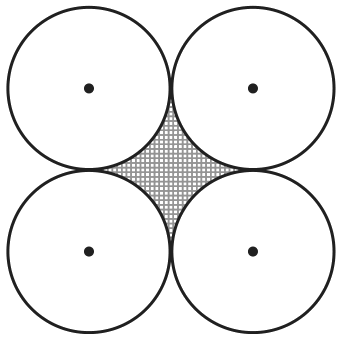
- (1) 38.5 sq.cm.
- (2) 10.5 sq.cm.
- (3) 18.5 sq.cm.
- (4) 18.2 sq.cm.
Why: Join the four centres: a square of side 7 cm, area 49 sq.cm. Inside it are four quarter circles = one full circle = 22/7 × 3.5 × 3.5 = 38.5 sq.cm. Shaded part = 49 − 38.5 = 10.5 sq.cm.
34.The mean of 25, 18, x, 20, 17, 20, 21, 25 is 21. Find the value of x.
- (1) 24
- (2) 20
- (3) 23
- (4) 22
Why: Total = 21 × 8 = 168. Sum of the other seven = 146. x = 168 − 146 = 22.
35.Which term should be added to 49x² + 149x² to make the expression a complete square. (Choose two correct alternatives.) Two correct options
- (1) –2
- (2) –14x
- (3) 2
- (4) 14x
Why: (7x + 1/7x)² = 49x² + 2 + 1/49x² and (7x − 1/7x)² = 49x² − 2 + 1/49x². So add 2 or −2.
Direction - Q. 36 and Q. 37. The following pie diagram represents number of fruit plants planted by a farmer. Observe the figure and select the correct alternative to answer the questions.
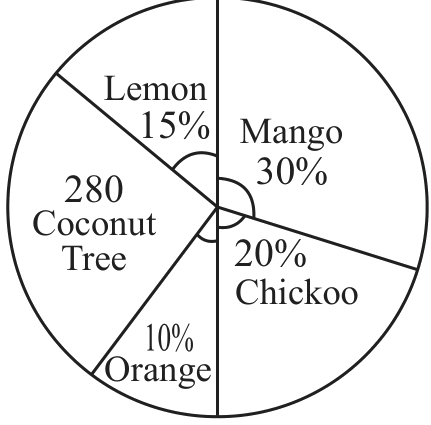
36.Find the total number of trees planted by the farmer.
- (1) 1120
- (2) 1020
- (3) 1220
- (4) 1040
Why: Other trees = 15 + 30 + 20 + 10 = 75%. So coconut = 25% = 280 trees. Total = 280 × 4 = 1120.
37.Find the number of trees bearing multi-seed fruits.
- (1) 896
- (2) 504
- (3) 208
- (4) 616
Why: Mango and coconut have one seed. Lemon, chickoo and orange have many seeds: 15 + 20 + 10 = 45%. 45% of 1120 = 504.
38.Solve → (2x² + 5x – 8) + (7x² – 9x + 3) – (9x² – 4x – 6)
- (1) 0
- (2) x – 1
- (3) x + 1
- (4) 1
Why: x² terms: 2 + 7 − 9 = 0. x terms: 5 − 9 + 4 = 0. Numbers: −8 + 3 + 6 = 1. Answer = 1.
39.Find the value of x² – 4x² + 3x – 10 × x² + 2x – 15x² – x – 6
- (1) (x – 2)
- (2) x + 5
- (3) 1
- (4) 2
Why: Factorise: (x − 2)(x + 2) / (x + 5)(x − 2) × (x + 5)(x − 3) / (x − 3)(x + 2). Every factor cancels. Answer = 1.
40.Write the degree of the product of the polynomials (16x4 + 81), (16x4 – 81)
- (1) 4
- (2) 16
- (3) 12
- (4) 8
Why: The product is 256x8 − 6561. The highest power of x is 8.
41.There are some birds in a sanctuary. One half of them are flying in the sky. One third are sitting on the tree and 18th birds are pecking grains on the floor. The remaining 45 birds are swimming in the lake. Find the total number of birds.
- (1) 1248
- (2) 1040
- (3) 1024
- (4) 1080
Why: 1/2 + 1/3 + 1/8 = 12/24 + 8/24 + 3/24 = 23/24. Remaining = 1/24 = 45 birds. Total = 45 × 24 = 1080.
42.The area of an equilateral triangle is 100√3 sq.cm. Find the perimeter of that equilateral triangle.
- (1) 60 cm
- (2) 50 cm
- (3) 48 cm
- (4) 81 cm
Why: Area = (√3/4) × side² = 100√3. So side² = 400 and side = 20 cm. Perimeter = 3 × 20 = 60 cm.
43.Find the quotient and the remainder when the polynomial (x³ + 2x² – x – 2) is divided by (x + 2). Choose the correct alternative.
- (1) Quotient = (x² + 1), R = 1
- (2) Quotient = (x² – 1), R = 2
- (3) Quotient = (x² – 1), R = 0
- (4) Quotient = (x² + x – 1), R = 0
Why: x³ + 2x² − x − 2 = x²(x + 2) − 1(x + 2) = (x + 2)(x² − 1). So quotient = x² − 1 and remainder = 0.
44.The ratio of the ages of Anil and Sunil 4 years before was 4:5. Four years hence, the ratio of their ages will be 6:7. Find present age of Anil.
- (1) 16 years
- (2) 20 years
- (3) 24 years
- (4) 22 years
Why: Let ages 4 years ago be 4k and 5k. Four years hence they are 4k + 8 and 5k + 8. (4k + 8)/(5k + 8) = 6/7 gives 28k + 56 = 30k + 48, so k = 4. Anil now = 16 + 4 = 20 years.
45.Find the value of 712 hours + 8 hours 45 minutes + 5.25 hours.
- (1) 21 hours 00 minutes
- (2) 21 hours 20 minutes
- (3) 20 hours 30 minutes
- (4) 21 hours 30 minutes
Why: 7.5 + 8.75 + 5.25 = 21.5 hours = 21 hours 30 minutes.
46.In the adjoining figure □PQRS is a parallelogram. One of its side is 60 m. and other side is 25 m. If l(SM) = 7 m. Find area of □PQRS. 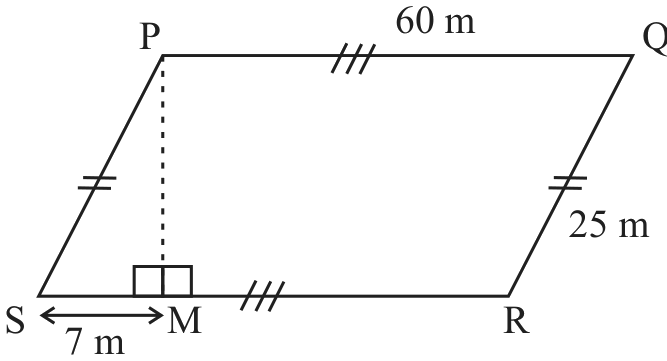
- (1) 1440 sq.m.
- (2) 1500 sq.m.
- (3) 1560 sq.m.
- (4) 1660 sq.m.
Why: In right triangle PMS: PM² = 25² − 7² = 625 − 49 = 576, so PM = 24 m. Area = base × height = 60 × 24 = 1440 sq.m.
47.Find the capacity of a cubical tank having each side 1.5 m. (Select two correct alternative.) Two correct options
- (1) 3375 lit
- (2) 4375 lit
- (3) 3.375 cubic m
- (4) 4.375 cubic m
Why: Volume = 1.5 × 1.5 × 1.5 = 3.375 cubic m. 1 cubic m = 1000 litre, so 3375 litre.
48.A shopkeeper sold two articles for Rs. 1200 each. After selling he earned 20% profit on one article and suffered 20% loss on the other article. Find percent profit or loss in this transaction.
- (1) 4% profit
- (2) 6% profit
- (3) 4% loss
- (4) 6% loss
Why: Cost of first = 1200 ÷ 1.2 = 1000. Cost of second = 1200 ÷ 0.8 = 1500. Total cost 2500, total sale 2400. Loss = 100 = 4%.
49.Find the value of (225)² – 1(15)² + 1
- (1) 224
- (2) 226
- (3) 326
- (4) 225
Why: (225)² − 1 = (225 − 1)(225 + 1) = 224 × 226. And 15² + 1 = 226. So the value = 224.
50.Solve → 4 decam 5 m 7 decim + 5 decam 8 m 9 decim. + 2 decam 8 m 4 decim
- (1) 2.35 km.
- (2) 235 metre
- (3) 133 meter
- (4) 1.33 km.
Why: 45.7 m + 58.9 m + 28.4 m = 133 m.
51.The difference between half circumference of a circle and its diameter is 4 cm. Find the area of the circle.
- (1) 154 sq.cm.
- (2) 77 sq.cm.
- (3) 19.25 sq.cm.
- (4) 38.50 sq.cm.
Why: Half circumference − diameter = 22r/7 − 2r = 8r/7 = 4, so r = 3.5 cm. Area = 22/7 × 3.5 × 3.5 = 38.5 sq.cm.
52.The difference between the smallest natural number and the greatest negative integer is the square root of one of the following numbers given in the alternatives. Find the number.
- (1) 2
- (2) 1
- (3) 4
- (4) 9
Why: Smallest natural number = 1. Greatest negative integer = −1. 1 − (−1) = 2, and 2 is the square root of 4.
53.Find the capacity of a cylindrical cement tank of water, if the diameter of the tank is 7m and height is 2 m. (Select two correct alternatives.) Two correct options
- (1) 88 cubic m
- (2) 77 cubic m
- (3) 88000 litres
- (4) 77000 litres
Why: Volume = πr²h = 22/7 × 3.5 × 3.5 × 2 = 77 cubic m = 77000 litres.
54.Find the additive inverse of the product of multiplicative inverse of 6557 and multiplicative inverse of 7691.
- (1) +2120
- (2) –2120
- (3) +2021
- (4) –2021
Why: Multiplicative inverses: 57/65 and 91/76. Product = (57 × 91)/(65 × 76) = (3 × 7)/(5 × 4) = 21/20. Additive inverse = −21/20.
55.Find the value of
0.545454 + 0.5454 + 0.54
0.545454 + 0.5454 + 0.54
- (1) 1.630854
- (2) 1.531854
- (3) 1.631854
- (4) 1.631845
Why: Write all with six decimal places: 0.545454 + 0.545400 + 0.540000 = 1.630854.
56.Which of the following number given in the alternatives divides exactly all the numbers 161, 371, 301, 637, 553, ?
- (1) 9
- (2) 3
- (3) 7
- (4) 11
Why: 161 = 7 × 23, 371 = 7 × 53, 301 = 7 × 43, 637 = 7 × 91, 553 = 7 × 79.
57.A triangular plot has sides 50 m, 30 m and 40 m. Find the area of the triangular plot. (Select two correct alternatives) Two correct options
- (1) 1500 sq.m.
- (2) 600 sq.m.
- (3) 6 Are
- (4) 15 Are
Why: 30² + 40² = 50², so it is a right triangle. Area = ½ × 30 × 40 = 600 sq.m. 1 Are = 100 sq.m, so 600 sq.m = 6 Are.
58.Find the value of x, if 3x + 3x+1 = 108
- (1) 7
- (2) 5
- (3) 4
- (4) 3
Why: 3x + 3 × 3x = 4 × 3x = 108. So 3x = 27 = 3³ and x = 3.
59.L.C.M. of two consecutive odd numbers is 8463. Find the bigger odd number out of the two numbers.
- (1) 91
- (2) 93
- (3) 95
- (4) 97
Why: Two consecutive odd numbers have no common factor, so their L.C.M. is their product. 91 × 93 = 8463. The bigger number is 93.
60.Find the value of
√31 × 32 × 30 × 33 + 1
√31 × 32 × 30 × 33 + 1
- (1) 990
- (2) 923
- (3) 1021
- (4) 991
Why: 30 × 33 = 990 and 31 × 32 = 992. 990 × 992 + 1 = (991 − 1)(991 + 1) + 1 = 991². Square root = 991.
61.Find the average of the cubes of first five odd natural numbers.
- (1) 235
- (2) 255
- (3) 245
- (4) 285
Why: 1 + 27 + 125 + 343 + 729 = 1225. Average = 1225 ÷ 5 = 245.
62.In the adjoining figure line l || line m and line p is the transversal. Observe the figure and find the value of ∠w. 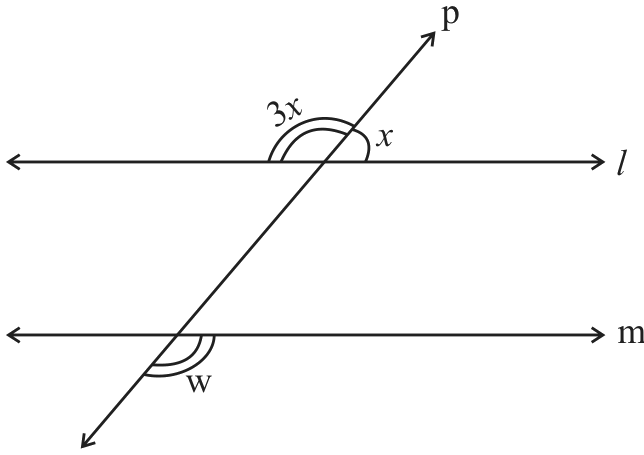
- (1) 45°
- (2) 135°
- (3) 130°
- (4) 90°
Why: 3x and x form a straight line, so 4x = 180° and x = 45°, 3x = 135°. Angle w is on the same side and in the same position as the angle opposite to 3x, so w = 135°.
63.Area of a circle is in direct variation with the square of the radius of the circle. If the area of a circle is 616 sq.cm., then the radius is 14 cm. Find the area of the circle whose radius is 42 cm.
- (1) 5544 sq.cm.
- (2) 3850 sq.cm.
- (3) 2464 sq.cm.
- (4) 4455 sq.cm.
Why: The radius becomes 3 times (14 to 42), so the area becomes 3² = 9 times. 616 × 9 = 5544 sq.cm.
64.How many more segments are formed by joining six collinear points to each other than by joining five non-collinear points to each other?
- (1) 9
- (2) 7
- (3) 8
- (4) 5
Why: Every pair of points gives one segment. Six points: 6 × 5 ÷ 2 = 15. Five points: 5 × 4 ÷ 2 = 10. 15 − 10 = 5.
65.The radius of a semi-circular garden is 420 m. It is to be fenced with five rounds of wire. If the wire costs Rs. 60 per metre. What will be the cost of the wire needed for fencing?
- (1) ₹ 64,800
- (2) ₹ 6,48,000
- (3) ₹ 3,24,000
- (4) ₹ 32,400
Why: Boundary = half circumference + diameter = 22/7 × 420 + 840 = 1320 + 840 = 2160 m. Five rounds = 10800 m. Cost = 10800 × 60 = ₹ 6,48,000.
66.In the adjoining ΔPQR, ray PA and ray QB are the bisectors of ∠P and ∠Q respectively. If ∠R = 70°. Find m∠PMQ. 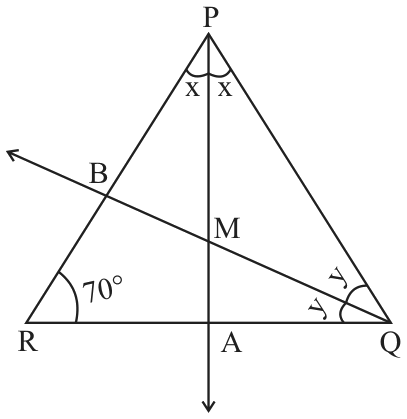
- (1) 120°
- (2) 130°
- (3) 125°
- (4) 135°
Why: ∠P + ∠Q = 180° − 70° = 110°, so x + y = 55°. In ΔPMQ, ∠PMQ = 180° − 55° = 125°.
67.In the adjoining ΔPQR, ∠AQP = 130°, ∠BRP = 140°, l(PQ) = 16 cm, l(PR) = 12 cm. Find l(QR) 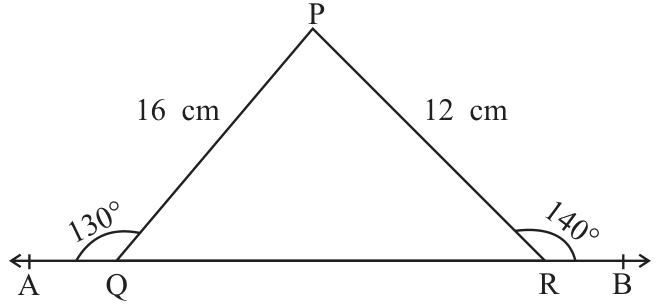
- (1) 17 cm
- (2) 25 cm
- (3) 18 cm
- (4) 20 cm
Why: ∠PQR = 180° − 130° = 50° and ∠PRQ = 180° − 140° = 40°. So ∠P = 90°. By Pythagoras, QR² = 16² + 12² = 400, QR = 20 cm.
68.A shopkeeper sold a fan having marked price Rs. 2300 at discounted price Rs. 2001. Find the percent discount given by the shopkeeper.
- (1) 23%
- (2) 17%
- (3) 13%
- (4) 15%
Why: Discount = 2300 − 2001 = 299. 299 ÷ 2300 × 100 = 13%.
69.Opposite angles of a cyclic quadrilateral are (3x + 10)° and (4x + 30)°. Find the measures of these angles.
- (1) 70°, 110°
- (2) 115°, 65°
- (3) 120°, 60°
- (4) 112°, 68°
Why: Opposite angles of a cyclic quadrilateral add to 180°. 7x + 40 = 180, x = 20. Angles = 70° and 110°.
70.In the adjoining ΔPQR, ∠PQR = 90° and QM ⊥ PR, PQ = 12 cm, QR = 16 cm. Find l(QM) 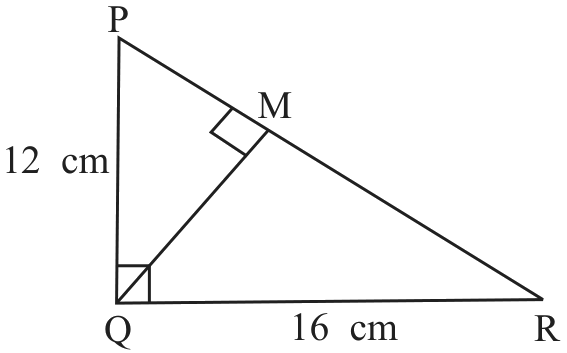
- (1) 2.4 cm
- (2) 19.2 cm
- (3) 4.8 cm
- (4) 9.6 cm
Why: PR = √(12² + 16²) = 20 cm. Area = ½ × 12 × 16 = ½ × 20 × QM. So QM = 192 ÷ 20 = 9.6 cm.
71.In the adjoining figure □PQRS is a square having side 28 cm. Points A, B, C and D are the midpoints of side PQ, side QR, side RS, side SP respectively. Find the area of square ABCD. 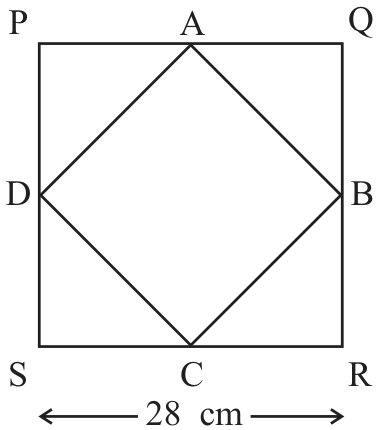
- (1) 784 sq.cm.
- (2) 392 sq.cm.
- (3) 196 sq.cm.
- (4) 616 sq.cm.
Why: Joining the midpoints cuts off four corner triangles, each 1/8 of the big square. So ABCD is half of PQRS = 784 ÷ 2 = 392 sq.cm.
72.A train of length 1000 m. is running at a speed of 72 km/hr. How much time will it take to pass a tunnel of length 800 m? (Choose two correct alternatives.) Two correct options
- (1) 90 seconds
- (2) 112 minutes
- (3) 2 minutes
- (4) 120 seconds
Why: Distance = 1000 + 800 = 1800 m. Speed = 72 km/hr = 20 m/s. Time = 1800 ÷ 20 = 90 seconds = 1½ minutes.
73.The amount of certain principal at certain rate of interest after 5 years is Rs. 10800 with simple interest and the amount for the same principal and at the same rate of interest after 3 years is Rs. 9680 with simple interest. Find the principal and the rate of interest.
- (1) P = ₹ 7000, R = 8%
- (2) P = ₹ 8000, R = 9%
- (3) P = ₹ 9000, R = 7%
- (4) P = ₹ 8000, R = 7%
Why: Interest for 2 years = 10800 − 9680 = 1120, so 560 per year. Principal = 9680 − 3 × 560 = 8000. Rate = 560 ÷ 8000 × 100 = 7%.
74.Due to increase in the prices of fruits by 20%, the sale was decreased by 10%. Find the percent increase or decrease in the income of the fruitseller.
- (1) 10% increase
- (2) 8% increase
- (3) 8% decrease
- (4) 10% decrease
Why: Take income 100. New income = 120 × 90/100 = 108. That is an 8% increase.
75.The radius of the base of a cone is 21 cm and its height is 20 cm. Find its volume.
- (1) 9204 cubic cm
- (2) 9042 cubic cm
- (3) 9240 cubic cm
- (4) 9273 cubic cm
Why: Volume = 1/3 × 22/7 × 21 × 21 × 20 = 9240 cubic cm.
Answer Key
As per the final answer key of the Maharashtra State Council of Examination, Pune. Question number, then the correct option.
1 · 4
2 · 2
3 · 4
4 · 3 & 4
5 · 2 & 3
6 · 1
7 · 3
8 · 2
9 · 1 or 2
10 · 2
11 · cancelled · all
12 · 4
13 · 3
14 · 3
15 · 1
16 · 2
17 · 2 or 4
18 · cancelled · all
19 · 4
20 · 3
21 · 2
22 · 3
23 · 4
24 · 1
25 · 1 & 4
26 · 3
27 · 1
28 · 2 & 3
29 · 4
30 · 2
31 · 4
32 · 1
33 · 2
34 · 4
35 · 1 & 3
36 · 1
37 · 2
38 · 4
39 · 3
40 · 4
41 · 4
42 · 1
43 · 3
44 · 2
45 · 4
46 · 1
47 · 1 & 3
48 · 3
49 · 1
50 · 3
51 · 4
52 · 3
53 · 2 & 4
54 · 2
55 · 1
56 · 3
57 · 2 & 3
58 · 4
59 · 2
60 · 4
61 · 3
62 · 2
63 · 1
64 · 4
65 · 2
66 · 3
67 · 4
68 · 3
69 · 1
70 · 4
71 · 2
72 · 1 & 2
73 · 4
74 · 2
75 · 3
Advertisement